All work

IP / Patents · Marketplace · AI · 2024 — 2025

Nobody will tell you their best idea until you can prove you won't take it.

MindMiner is a two-sided marketplace for invention: companies post the problems they cannot solve, inventors submit ideas, and the ones that get used turn into patents and payouts. The entire product rests on one thing — an inventor believing their idea is safe the moment they type it in.

Product Manager · MindMiner · Visit the live product ↗

2-sided
Inventors and companies, each useless without the other
Daily
New challenge cadence the marketplace runs on
IP
Protection and payout guarantees as product features, not policy
3
Participant types — inventors, companies, influencers
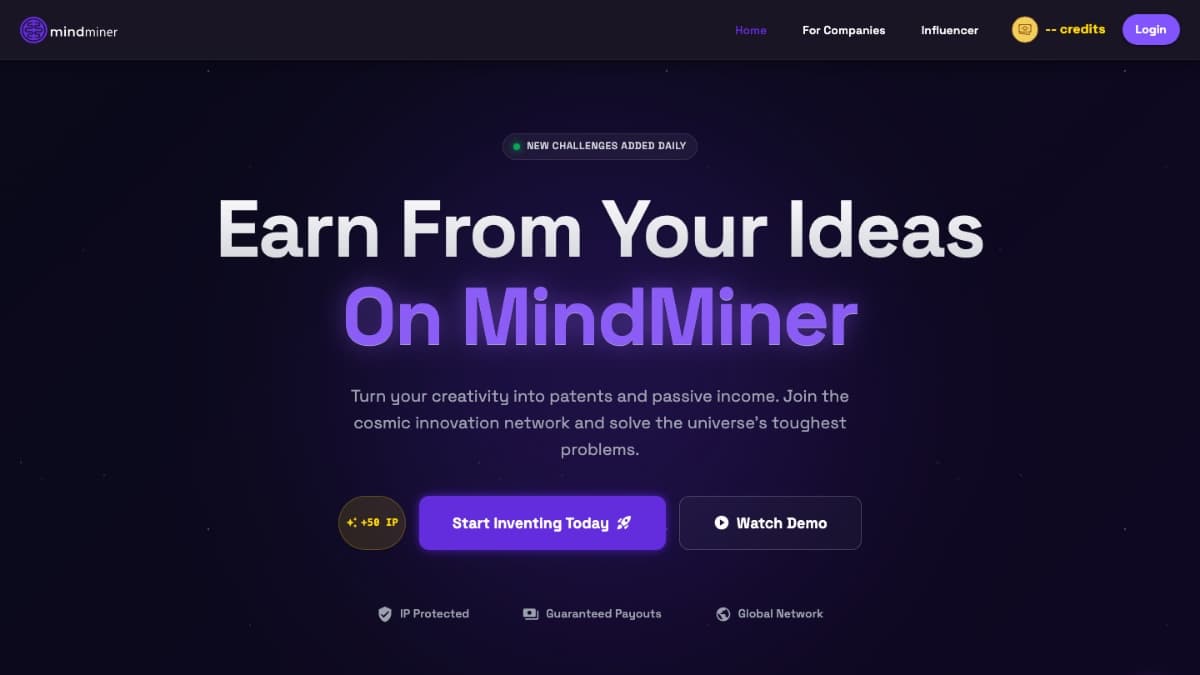
MindMiner homepage — 'Earn From Your Ideas On MindMiner', inviting inventors to turn creativity into patents and passive income, with IP Protected, Guaranteed Payouts and Global Network as the trust markers.

Executive Summary

The product is a trust mechanism wearing a marketplace interface.

Open innovation has an obvious shape and a hard centre. Companies have problems they cannot solve internally; there are people outside who can solve them. Connecting the two looks like a directory problem and is not.

It is a disclosure problem. An idea has no value until it is described, and describing it is exactly what makes it possible to take without paying. Every inventor knows this, which is why the good ones stay quiet — and a marketplace with only the ideas people were relaxed about sharing is a marketplace of weak ideas.

So the product leads with the guarantees rather than the catalogue. IP protection, guaranteed payouts and a global network are stated before a single challenge is shown, because they are the actual product. The challenge feed, the credits, the IP points are all mechanisms for making participation feel survivable enough to start.

At a glance

Role
Product Manager
Product
MindMiner
Domain
IP / patents · open innovation
Users
Inventors, companies, influencers
Timeline
2024 — 2025
Model
Challenge marketplace with IP protection and payouts

Section 02 — The Problem

Three participants, and every one of them has a reason to walk away.

Inventors

Describing the idea is what puts it at risk.

The disclosure paradox is not a UX problem you can design around with reassuring copy. Until an inventor believes submission creates a record that favours them, the rational move is to submit nothing worth having.

Companies

Volume without filtering is a cost, not a benefit.

A company that receives four hundred submissions has bought itself four hundred evaluations. Open innovation fails on the review burden far more often than it fails on idea quality.

Both

A payout promise is only worth the mechanism behind it.

Guaranteed payouts is a strong claim, and strong claims are load-bearing. The first time someone contributes a used idea and is not paid, the story travels further than any marketing did.

Section 03 — Research & Discovery

The question was what makes a good inventor start, not what makes them stay.

Retention is the wrong first problem here. A marketplace like this dies at first submission — the moment someone with a genuinely valuable idea decides the risk is not worth the expected return and closes the tab.

That reframes discovery around a narrow question: what has to be visibly true, before signing up, for a cautious expert to type their idea into someone else's website. Everything on the landing surface is downstream of that answer, which is why the guarantees appear above the challenge feed rather than in a policy page.

Method

Ask the people who did not submit.

The informative population is the one that arrived, read the terms and left. Everyone who completed a submission had already accepted the trade — they can tell you about the form, not about the fear.

Method

The terms are product copy, not legal boilerplate.

In a product whose core promise is 'your idea stays yours', the IP terms are the highest-stakes text on the site. Treating them as a legal artefact to be linked rather than a product surface to be designed is how trust products quietly fail.

Section 04 — Current State Analysis

What each side puts in, and what it needs back.

ParticipantPuts inNeeds back
InventorIdeas against open challengesProvable IP ownership and a real payout path
CompanyProblems, evaluation time, prize fundingSignal over volume, and clean rights on what it uses
InfluencerReach into technical communitiesA product credible enough to recommend
PlatformProtection, adjudication, payout mechanicsEnough of both sides to make the third worth having
Participants, contributions and the guarantee each one depends on

Before / After

Open innovation without a trust layer is just an inbox.

The activity is the same in both columns — a company has a problem and someone outside has an answer. What changes is whether the person with the answer is willing to say it.

Before

Unprotected

Sending an idea to a company

  1. Company publishes a problem

  2. Inventor decides whether disclosure is safe — and usually decides it is not

    Disclosure risk
  3. Anything submitted arrives with unclear ownership

    No record
  4. Company sifts volume with no reliable signal

The strongest ideas are the ones least likely to be sent, which inverts the quality of everything received.

After

Protected

Submitting through MindMiner

  1. Company posts a challenge with a stated reward

  2. Submission creates a timestamped, attributed record

  3. Evaluation happens against declared criteria

  4. Used ideas convert into patents and payouts

Protection and payout are mechanisms in the flow, not promises in a footer — which is what makes a cautious expert willing to start.

Protected
Ownership established at submission, not negotiated afterwards
Declared
Evaluation criteria published with the challenge, not applied privately

Section 05 — Competitive Research

The competition is an inventor deciding to keep quiet.

Rival platforms are not what this product mostly loses to. It loses to inaction — the expert who reads the page, concludes the asymmetry is not in their favour, and keeps the idea for a patent they may never file.

That sets the bar differently. Beating another marketplace on features is a smaller job than beating the default of silence, and the things that beat silence are legibility and evidence: clear ownership terms, a visible payout mechanism, and named examples of people who were actually paid.

The real alternative

File it yourself, or sit on it.

Both are free and neither requires trusting a stranger. The platform has to be clearly better than doing nothing, which is a higher bar than being better than a competitor.

The proof that converts

Somebody like me got paid.

Trust in this category is transferred, not argued. One credible, specific payout story does more than any amount of copy about protection — which makes surfacing those stories a product decision, not a marketing one.

Section 06 — Key Insights

Three things that decide whether a marketplace like this works.

Insight 01

Lead with the guarantee, not the catalogue.

The instinct is to show challenges first, because that is the content. But nobody evaluates a challenge before deciding whether participating is safe — so protection and payout have to clear that gate first.

Insight 02

Seed the side that is harder to fake.

Challenges can be commissioned; credible inventors cannot. The scarce side sets the pace, and every growth decision should be read against whether it makes that side more or less willing to participate.

Insight 03

Points are a promise the platform has to honour.

IP points and credits are engagement mechanics, but they sit next to a real financial claim. Anything that looks like a game beside anything that looks like money makes users ask which one the payout resembles — and the answer must always be the money.

Section 07 — Design Strategy

Four rules for a product built on other people's trust.

  1. Every claim on the surface must have a mechanism behind it.

    'Guaranteed payouts' is either a system or a liability, and users find out which one at the worst possible moment.

  2. Establish ownership at submission, never afterwards.

    Rights negotiated after disclosure are negotiated from the weaker position, and inventors know it.

  3. Publish the evaluation criteria with the challenge.

    An opaque decision after an idea has been handed over reads as a taking, whatever the intent was.

  4. Protect the scarce side first.

    Companies can be recruited; inventors with valuable ideas leave quietly and do not come back.

Section 08 — The System

Every submission moves through states with different rights attached.

Submitted

The idea exists on the platform as a timestamped, attributed record. Ownership is established here or it is never established at all.

Under evaluation

Assessed against the criteria published with the challenge. The inventor's rights do not weaken because a company is now reading it.

Awarded or released

Either it converts into a patent path and a payout, or the idea returns to the inventor cleanly. The second outcome matters as much as the first.

The third state is the one that earns repeat participation. An inventor whose idea was not selected but who walked away with their rights intact will submit again; one who is unsure what happened to it will not, and will say so publicly.

Section 09 — The Features

What the platform does.

MindMiner's landing surface — 'Earn From Your Ideas', with Start Inventing Today and Watch Demo, and IP Protected, Guaranteed Payouts and Global Network stated beneath.
Marketplace

A challenge feed with the guarantees stated up front.

Companies post problems with rewards attached and new challenges arrive daily, but the first thing the product asserts is IP protection, guaranteed payouts and the reach of the network — because that is what determines whether anyone participates at all.

1Company posts a challenge2Inventor submits — record created3Evaluated against stated criteria4Patent path and payout, or clean release
Ownership, evaluation and payout as one connected path.
Trust mechanics

Ownership, evaluation and payout as one connected path.

A submission becomes an attributed record, evaluation runs against declared criteria, and a used idea converts into a patent path and a payment — with the unselected case returning rights cleanly rather than leaving them ambiguous.

Platform mechanicsSignup IP grantIP points balanceCreditsnever the sameReal moneyChallenge rewardPayout on usePatent path
Two separated tracks — signup grant, IP points and credits on one side as engagement mechanics, challenge rewards, payouts and the patent path on the other as real money, deliberately never presented as the same thing.
Participation

Credits and IP points, sitting carefully beside real money.

A signup grant and an accumulating IP balance lower the cost of starting, and are deliberately kept legible as engagement mechanics so they are never mistaken for the payout itself.

Section 10 — User Flow

The inventor's decision happens before step one.

  1. Arrive and assess whether this is safe.

    The real conversion point, and it happens before any account exists. Everything above the fold is doing this job.

  2. Sign up, with a starting IP grant.

    Lowers the cost of the first step for someone who has decided to try but not yet decided to commit an idea.

  3. Browse challenges and pick one worth thinking about.

    Where a daily cadence matters — a stale feed signals a marketplace nobody is using.

  4. Submit, creating an attributed record.

    The moment the product's central promise is either kept or broken.

  5. Track evaluation through to payout or release.

    Silence here is what loses inventors permanently, which makes status visibility a retention feature rather than a convenience.

Section 11 — End-User Experience

Confidence is the feature. The rest is packaging.

The branding is playful — a cosmic network, challenges, points. That tone is doing real work for a category that otherwise reads as intimidating and legalistic, and it lowers the perceived cost of trying.

It also carries a risk worth naming: the further the interface drifts toward a game, the more a user has to ask whether the money is real too. The line the product has to hold is that the invitation can be playful, but ownership and payment must always read as serious.

Section 12 — Impact & Outcomes

What the platform proves, and what still needs measuring.

2-sided
Marketplace with a third participant type layered on
Daily
Challenge cadence keeping the feed live
IP
Protection and payout built as mechanisms, not policies

Performance figures are not published, so none are claimed here. The measures that would settle it are specific to this model: submission rate per challenge, the proportion of submissions from repeat inventors, and time from award to payment.

The second is the one that actually matters. Anyone can attract a first submission with a signup bonus; a marketplace built on trust is working only when the people who have already been through the process choose to come back.

Section 13 — Reflection

What I would do differently, and what is still open.

Would do differently

Test the terms page as hard as the landing page.

The homepage gets the attention because it is where conversion is measured. But in a product whose promise is 'your idea stays yours', the IP terms are where a cautious expert actually decides — and that page deserved the same scrutiny as the hero.

Still open

Trust is asymmetric and does not average out.

A hundred clean payouts build credibility slowly; one disputed one undoes it fast, and publicly. That imbalance is structural in this category, and no amount of product design removes it — it only determines how carefully the edge cases are handled.

WhatsApp