All work

AI · B2B SaaS · MarTech · 2026

Five fragmented intent tools, replaced by one platform.

B2B marketing teams were stitching demand generation together across separate tools for ICP definition, account discovery, intent analysis, campaign activation and reporting. Lucy collapses all five into one AI-driven platform with Salesforce sync. I scoped the product and owned the full delivery lifecycle — functional scope, flows, architecture and the twelve-week plan that shipped it.

Product Manager — full lifecycle ownership · Lucy AI — for Lead2Pipeline

5 → 1
Fragmented intent tools collapsed into one platform
12
Weeks from rebrand to production handoff
6
Roles coordinated — product, design, AI, full-stack, QA, DevOps
2-week
Sprint cycle with demos and collaborative backlog
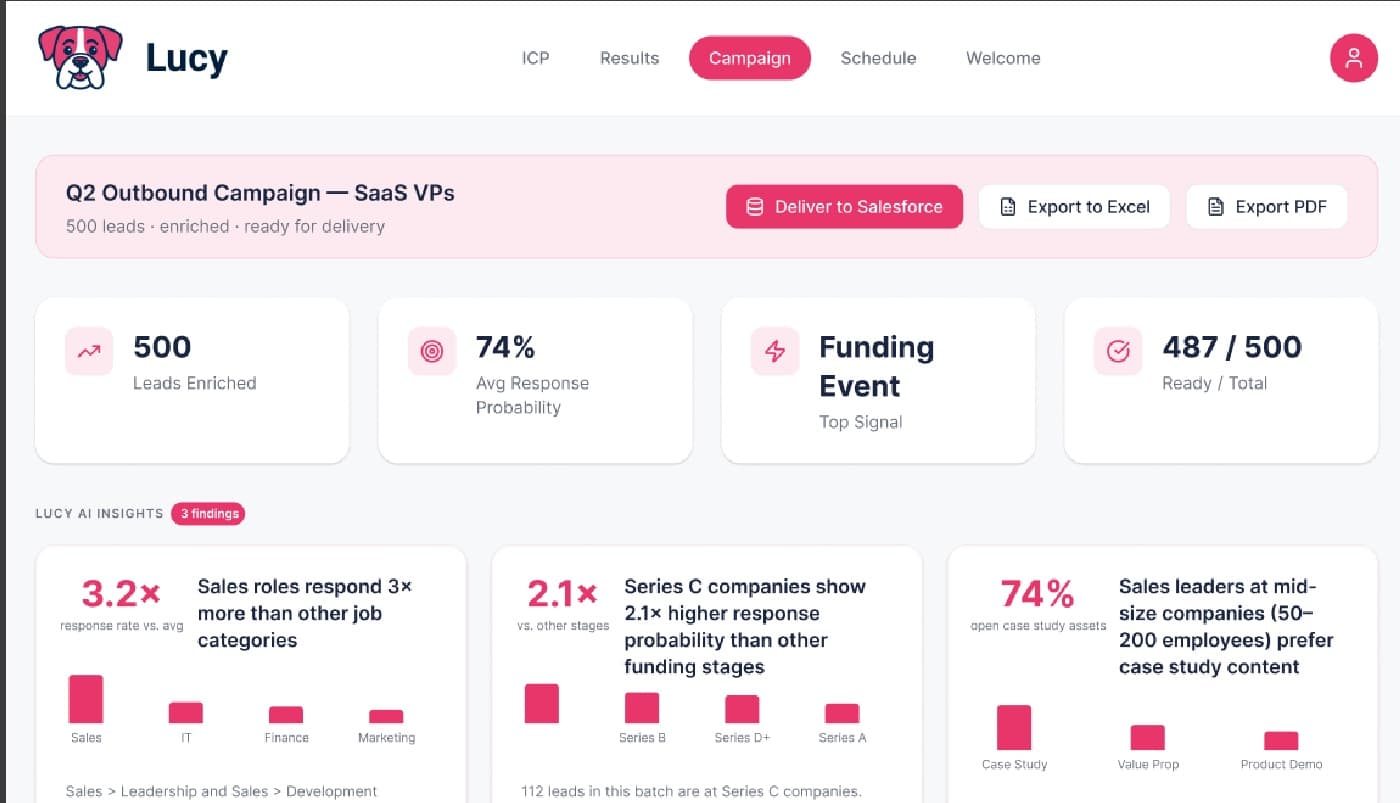
Lucy campaign view — 'Q2 Outbound Campaign — SaaS VPs, 500 leads enriched, ready for delivery', with Deliver to Salesforce and export actions, stat cards for leads enriched and average response probability, and three Lucy AI insight cards.

Executive Summary

The tools all worked. The seams between them did not.

Demand generation runs on intent signals — who is researching your category right now, and how strongly. The tooling for it had fragmented: one product to define an ideal customer profile, another to discover accounts, another to read intent, another to activate a campaign, another to report on it.

Every one of those handoffs is a place where context is lost and a signal ages. Lucy was scoped to remove the handoffs rather than improve any individual step — a single system covering ICP identification, account discovery, intent analysis, campaign activation and reporting, with Salesforce sync so it lands inside the sales workflow the team already runs.

I owned the full lifecycle: functional scope split between client and admin surfaces, the six-step client flow, the technical architecture, and a twelve-week delivery plan across six roles. Delivery ran on two-week sprints with a collaboratively prioritised backlog rather than fixed milestones, because a platform whose intent logic keeps evolving cannot be specified once and then built to a frozen scope.

At a glance

Role
Product Manager — full lifecycle
Client
Lead2Pipeline
Domain
Demand generation · intent data
Timeline
12 weeks to handoff
Delivery
2-week sprints, iterative scope

Section 02 — The Problem

Intent data has a shelf life, and every handoff spends it.

Fragmentation

Five tools, five definitions of the same account.

When ICP lives in one system and discovery in another, nobody can be certain the accounts being scored are the accounts the profile actually described. The reconciliation is manual and it is nobody's job.
Recency

A stale intent signal is worse than none.

Intent decays. A buying signal that reaches a rep a week late produces an outreach that reads as random, which costs more credibility than staying silent would have.

Workflow

Sales lives in the CRM, not in a marketing tool.

Intelligence that does not reach Salesforce does not reach the person making the call. Any platform that stops at its own dashboard has solved the analysis and skipped the point.

Section 03 — Research & Discovery

Scoping started from the workflow, not the feature wishlist.

The scoping question was which capabilities had to be in one system for the seams to actually disappear. Five came back as non-negotiable — ICP identification, account discovery, intent analysis, campaign activation and reporting — because a gap in any of them re-introduces a manual handoff and undoes the premise.

Salesforce integration was pulled into the same phase rather than deferred, for the same reason. Shipping the intelligence first and the CRM sync later would have meant launching a product that stopped one step short of the person who acts on it.

Scope decision

AI suggests the ICP; the client still owns it.

Onboarding was designed as guided configuration with AI-suggested profiles the client reviews and refines — not an automatic profile they inherit. An ICP nobody agreed to is one nobody trusts the scoring from.

Scope decision

Salesforce first, other CRMs later — and said out loud.

Supporting one CRM properly beats supporting three partially, because a half-working sync is worse than none: it produces records the sales team stops trusting. HubSpot and Pipedrive went on the roadmap in writing so the limit read as sequencing rather than an oversight.

Section 04 — Current State Analysis

What went into the MVP, and what was named as future scope.

CapabilityMVP scopeFuture scope
AI modelsLimited / off-the-shelfCustom-trained models
CRM supportSalesforce onlyHubSpot, Pipedrive
AutomationManual triggersFully automated workflows
Predictive analyticsBasicForecasting and predictive scoring
Architecture decisions — MVP scope versus deliberately deferred

Writing the future column down at proposal stage was deliberate. Multi-CRM support and custom models are the two things a buyer in this category always asks about, and the difference between a gap and a roadmap is whether you named it before they did.

Before / After

Five tools with four handoffs became one platform with none.

The capabilities are the same either way. What changes is how many times a list of accounts has to leave one system and be reconciled into another before anyone can act on it.

Before

5 tools

A stitched-together intent stack

  1. Define the ICP in one tool

  2. Discover accounts in another — and reconcile them against the profile by hand

    Manual handoff
  3. Read intent signals in a third

  4. Move the prioritised list into a campaign tool

    Manual handoff
  5. Report on performance somewhere else again

Every boundary is a place where context is lost, a signal ages, and no single system holds the whole picture.

After

1 platform

Lucy, with Salesforce sync

  1. ICP set up or AI-suggested, confirmed by the client

  2. Accounts and contacts discovered and enriched in place

  3. Intent scored and prioritised with source and recency shown

  4. Campaign activated or leads exported — same system

  5. Performance reported back against the same ICP

Salesforce sync carries accounts, contacts and intent scores into the CRM, so the output lands where sales already works.

5 → 1
Tools a team has to run, licence and train on
0
Manual reconciliation steps between discovery and activation
1
Definition of an account, shared across every step

Section 05 — Competitive Research

The competition was not another product. It was the stack they already paid for.

In a category this crowded, the realistic alternative is rarely a single rival platform — it is the collection of tools a team has already bought, integrated badly, and trained people on. That is a genuinely strong competitor, because switching costs are paid in retraining rather than licence fees.

This shaped two decisions directly. Salesforce sync went into the first phase so Lucy joined the existing workflow rather than asking teams to abandon it, and consolidation became the product's argument — the pitch is one fewer handoff, not a better intent score than any individual incumbent.

Positioning

Do not compete on scoring accuracy. Compete on the seams.

Any incumbent that does one of these five things does it well, and out-scoring a specialist at its own job is a race with no finish line. The defensible claim is the one none of them can make without becoming a different product: four fewer handoffs.

Commercials

A consolidation play is priced against the stack, not the seat.

The comparison a buyer actually runs is total cost of the tools being replaced plus the labour of reconciling them. That framing matters more than per-seat pricing, and it only works if the platform genuinely covers all five capabilities.

Section 06 — Key Insights

Three decisions that shaped the platform.

Insight 01

Show the source and the recency, not just the score.

An intent score on its own is a number a rep has to take on faith. Shown with where the signal came from and how fresh it is, it becomes evidence they can act on and defend.

Insight 02

Consolidation is the feature. Everything else supports it.

Beating any single incumbent on its own dimension is a losing race. Removing four handoffs is a claim none of them can match without becoming a different product.

Insight 03

Evolving logic cannot be planned on fixed milestones.

Intent scoring changes as real data arrives. Two-week sprints against a collaboratively prioritised backlog match how the product actually develops; a frozen scope would have locked in assumptions made before any real signal existed, then treated every correction as a change request.

Section 07 — Design Strategy

Four principles the platform was built on.

  1. One system, or the premise fails.

    A gap in any of the five capabilities re-introduces the handoff the product exists to remove.

  2. Land inside the CRM, not beside it.

    Salesforce sync shipped in phase one because intelligence that stops at a dashboard never reaches the rep.

  3. The client owns the ICP; the AI only proposes it.

    Scoring is only trusted downstream if somebody agreed to the profile it was derived from.

  4. Name the future scope before the client asks.

    Multi-CRM and custom models stated as roadmap read as sequencing; discovered later they read as gaps.

Section 08 — The System

Two surfaces, separated by who is accountable for what.

Client surface

Onboarding and ICP setup, account and contact discovery, intent visibility, campaign activation and export, performance reporting.

Admin surface

Client and campaign management, ICP and intent configuration controls, Salesforce sync monitoring, system health and activity logs.

Integration layer

Salesforce sync for accounts, contacts and intent scores, under role-based permissions with rate-limited APIs.

LayerTechnology
FrontendReact (Next.js), Tailwind CSS
BackendNode.js, API-based architecture
AuthenticationSupabase Auth / JWT
DatabasePostgreSQL (Supabase)
HostingVercel / AWS
IntegrationsSalesforce API
Access controlRole-based permissions
Technical stack

Section 09 — The Features

What the platform does.

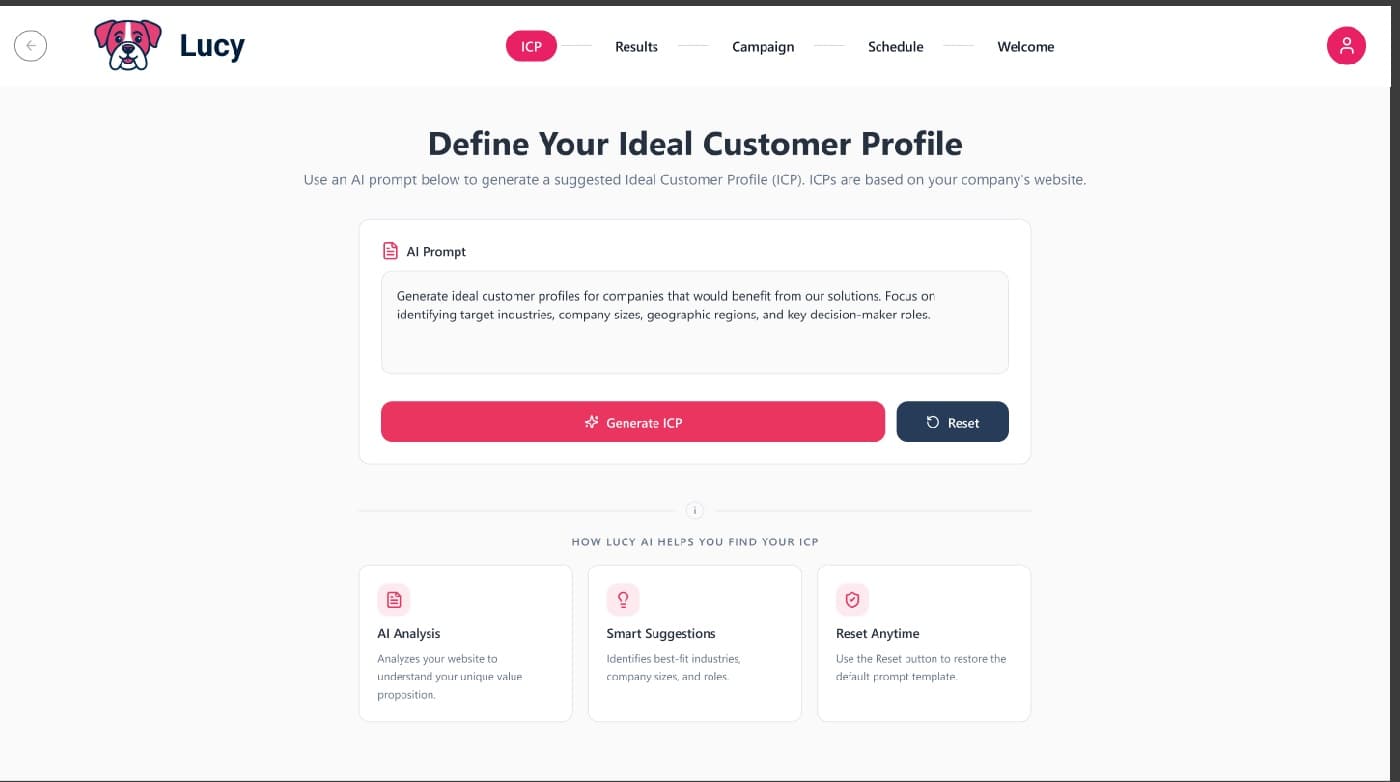
Lucy's Define Your Ideal Customer Profile screen — an AI prompt field with Generate ICP and Reset actions, above cards explaining AI analysis, smart suggestions and reset.
Client

Discovery and scoring, from anonymous visit to prioritised contact.

Guided onboarding with AI-suggested ICP refinement, anonymous account discovery via website tracking, contact enrichment filtered by role and firmographics, and intent scores shown with their source and recency rather than as a bare number.

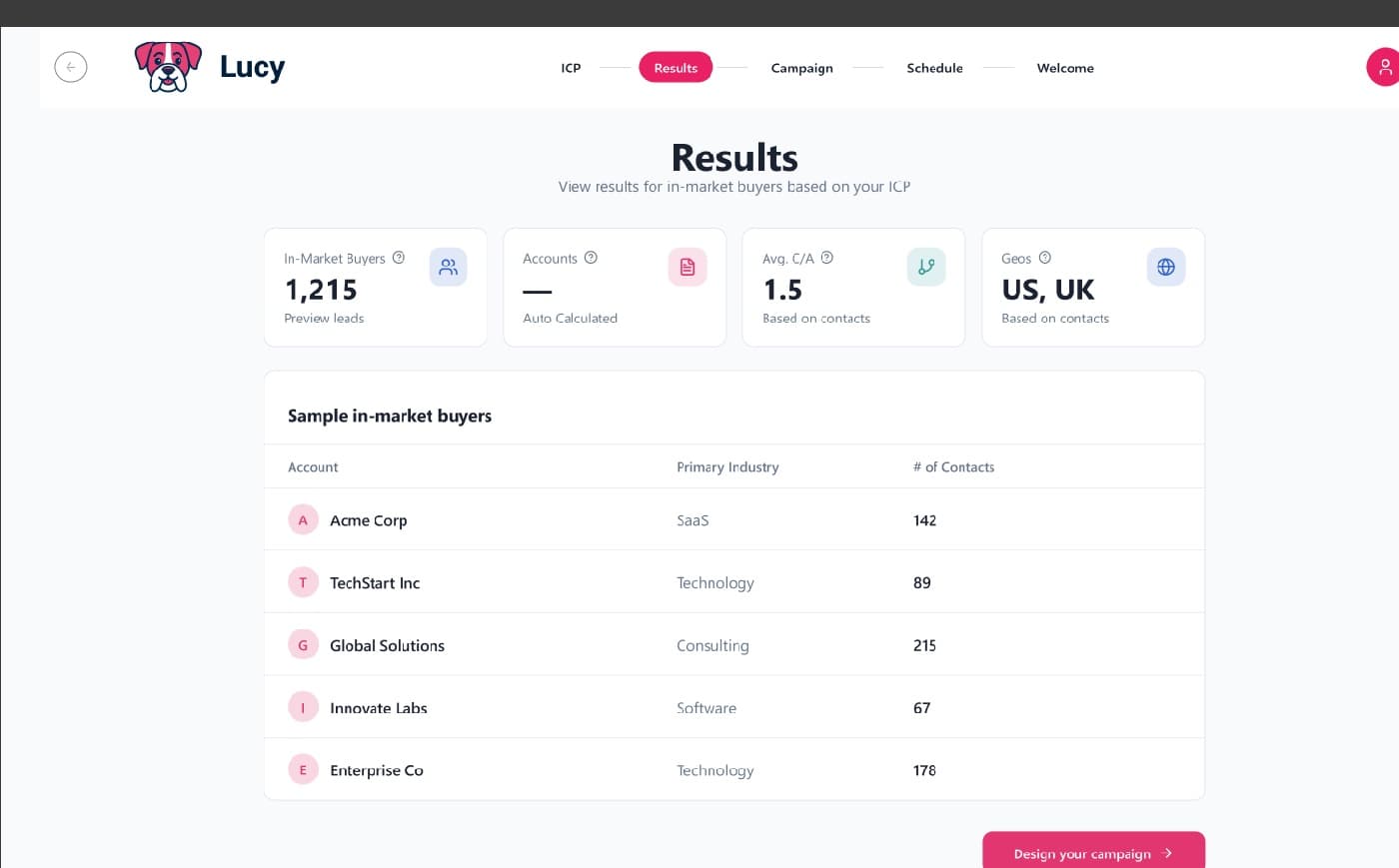
Lucy's Results screen — in-market buyer count, accounts, average contacts per account and geographies, above a table of sample in-market buyers with industry and contact counts.
Client

Results the client can interrogate before spending a campaign on them.

In-market buyer counts, average contacts per account and geography, alongside a sample of the accounts the ICP actually matched — shown before the client commits to activation.

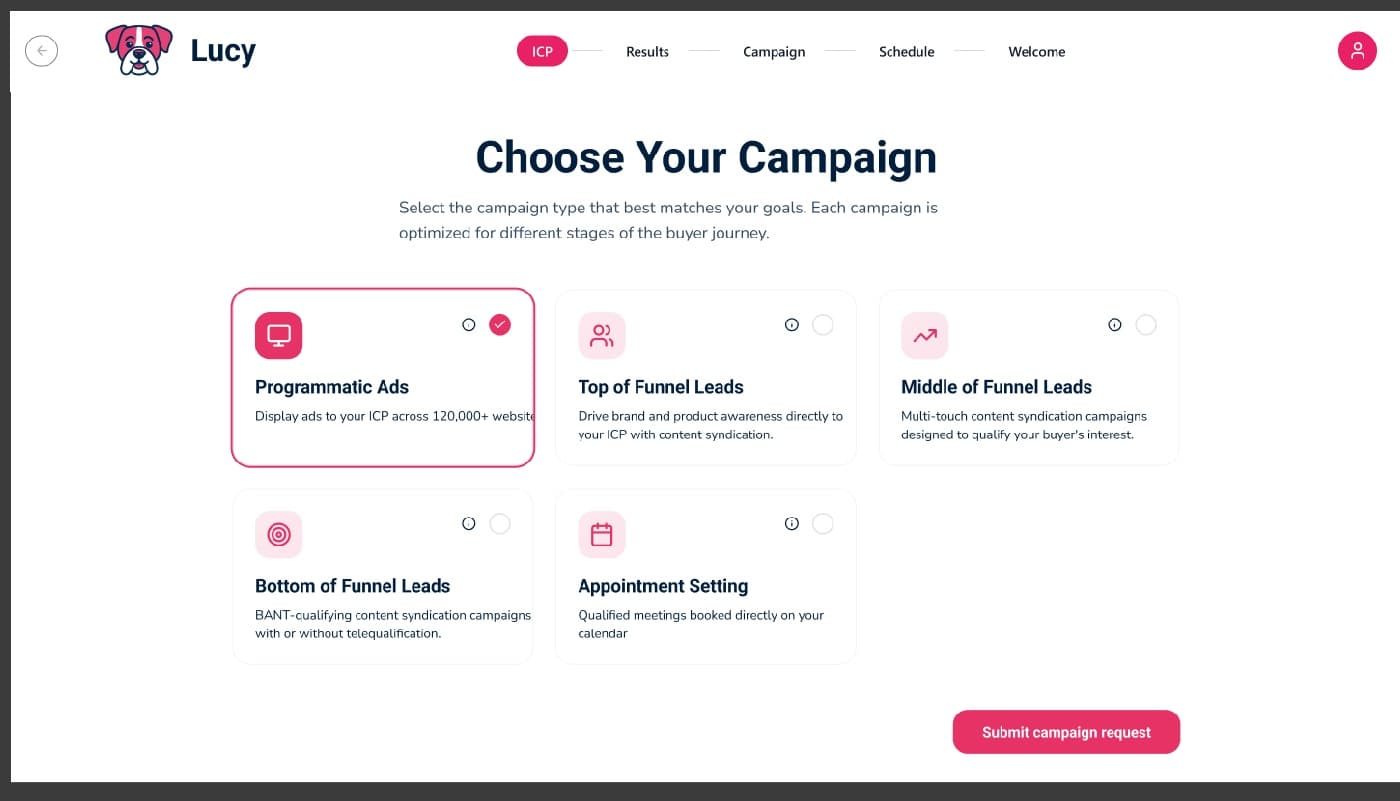
Lucy's Choose Your Campaign screen — selectable campaign types including programmatic ads, top and middle of funnel leads, bottom of funnel and appointment setting.
Client

Activation that ends in a campaign, not a dashboard.

Add-to-campaign and lead export workflows with performance reporting, so a signal becomes an action inside the same system that found it.

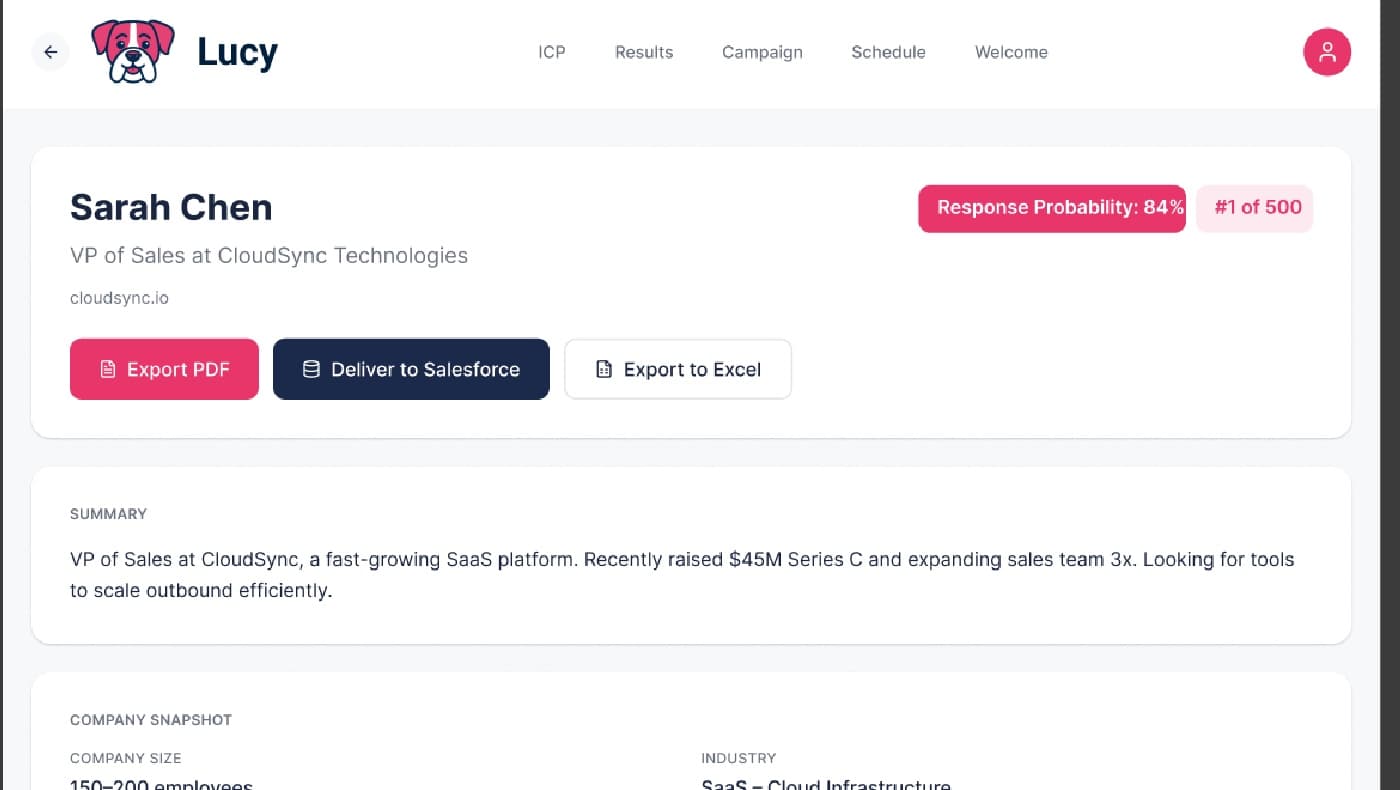
Lucy's lead detail view for a VP of Sales — response probability, company snapshot, sales signals including a funding round and hiring activity, and export actions to Salesforce, Excel and PDF.
Client

Every lead arrives with the reasoning attached.

A lead brief carries the response probability with the signals behind it — funding events, hiring, podcast mentions — plus what to say and what to avoid, then exports to Salesforce, Excel or PDF.

Admin control plane — one authenticated, permissioned surface governing client accounts, ICP and intent configuration, Salesforce sync and system health, each reporting its own status.
Admin

Operational control over clients, config and sync health.

Secure admin authentication, client and campaign management, ICP and intent configuration, Salesforce sync monitoring, and system health and activity logs.

Section 10 — User Flow

Six steps, and none of them leave the platform.

  1. Client logs into Lucy.

    Supabase Auth with role-based permissions; the admin surface is a separate authenticated context.

  2. Sets up an ICP, or reviews the AI-suggested one.

    Guided configuration. The profile is proposed by the system and confirmed by the client, never assumed.

  3. Lucy identifies accounts and contacts.

    Anonymous account discovery from website tracking, then contact enrichment filtered by role and firmographics.

  4. Intent signals are scored and prioritised.

    Each score carries its source and recency, so the ranking can be interrogated rather than trusted blindly.

  5. Client activates a campaign or exports the leads.

    The activation step lives in the same system as the discovery, which is the entire argument for consolidation.

  6. Performance is tracked on the dashboard.

    Engagement reporting closes the loop back to the ICP, so the profile improves with evidence.

The admin flow runs alongside it in four steps: secure login, review of client configurations, monitoring of campaigns and integrations, then system settings and reporting.

The point of listing it this way is that nothing in the sequence leaves the platform. On the previous stack, three of those six steps ended with an export and a re-import somewhere else.

Section 11 — End-User Experience

A marketer's real question is which twenty accounts to call today.

Nobody logs into a demand-gen platform to admire a scoring model. They log in to find out where to spend the day. Every design decision was measured against how quickly someone gets from opening the product to a prioritised, defensible list they can act on.

Showing source and recency alongside each score is the part that carries this. It converts a ranking into an argument the user can make to their own sales team, which is what determines whether the tool gets used after the first week.

The behavioural test for a product like this is whether reps work the list top-down. If they re-sort it by their own instinct, the scoring has not earned trust yet — and no amount of model accuracy fixes that if the reasoning is not visible alongside the score.

Section 12 — Impact & Outcomes

A twelve-week build, structured to keep evolving after it shipped.

WeeksFocus
1 — 2Rebranding and UI/UX design in Figma
3 — 4ICP setup and frontend foundation
5 — 6Account and contact discovery
7 — 8Intent scoring engine
9 — 10Campaign workflows and Salesforce integration
11 — 12Reporting, QA, deployment and handoff
Delivery plan — twelve weeks, two-week sprints
5 → 1
Capabilities consolidated into a single platform
12
Weeks from rebrand to production handoff
6
Roles coordinated across the delivery

Delivery was deliberately structured around a collaboratively prioritised backlog with weekly progress updates and sprint demos — so the intent logic could keep changing after launch without a change-request conversation every time.

Post-launch figures are not published, so none are claimed. The measure that would settle it is intent scoring against actual conversions — everything else describes activity, and only that comparison tells you whether the prioritisation was right.

Section 13 — Reflection

What I would do differently, and what is still open.

Would do differently

Define what a good intent score looks like before building the engine.

The scoring engine had a two-week slot in the plan, which assumes the hard part is implementation. The hard part is agreeing what correct means — and that is a conversation better had before the sprint than during it.

Still open

Consolidation only pays if all five parts are good enough.

Replacing five specialised tools with one platform means every capability is now compared against a product that did nothing else. The bet is that removing the handoffs outweighs being second-best at any single step — and that is validated by retention, not by launch.

WhatsApp