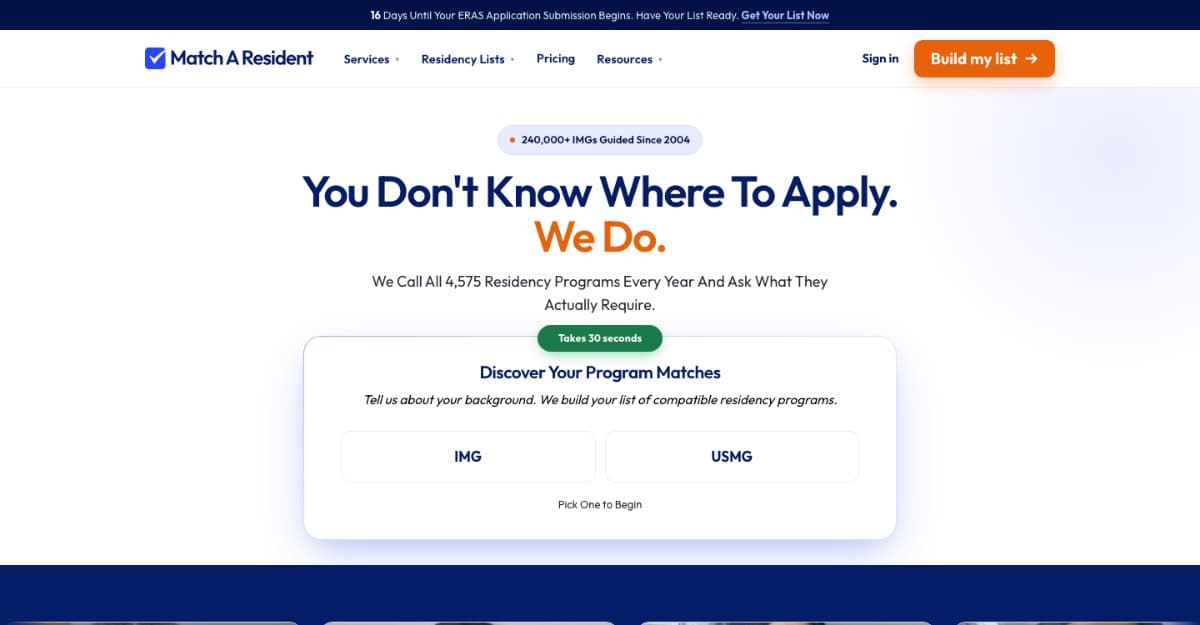
Applying to residency blind is the most expensive mistake in medicine.
International medical graduates apply to US residency programmes with almost no reliable signal about which ones will actually consider them — so most unmatched candidates spend their fees on programmes that were never going to open the file. Match A Resident replaces that guesswork with programme requirements verified by calling all 4,575 ACGME programmes every year.
The product is not advice. It is verified data nobody else collects.
A residency application is expensive, and an applicant only gets one cycle a year. The decision that determines the outcome is not how good the personal statement is — it is which programmes end up on the list.
Most of that list-building happens on rumour: forum posts, last year's spreadsheet, what a friend heard. Programme requirements are not reliably published, and they change. An applicant can spend a full cycle applying to programmes that filter them out on visa status or graduation year before a human reads a word.
Match A Resident's answer is unglamorous and hard to copy: call all 4,575 ACGME programmes every year, ask what they actually require, and build the compatibility list from that. The surrounding services — personal statement review, MyERAS review, interview prep, advising — sit on top of that data spine.
At a glance
Role
Product Manager
Organisation
Codingcops
Domain
HealthTech · EdTech
Users
IMG and USMG residency applicants
Timeline
2024 — 2025
Section 02 — The Problem
One cycle a year, and no reliable way to spend it well.
Information
Programme requirements are not reliably published.
What a programme says publicly and what it filters on are different things. Visa sponsorship, years since graduation, attempt history — the criteria that actually decide are often not on the website at all.
Cost
Every wasted application is real money and a real shot.
Applicants pay per programme. Applying to one that will never review the file is not a small inefficiency — it is spend removed from the applications that could have worked.
Stakes
There is no second attempt this year.
The match runs annually. A list built on bad information does not fail gradually — it fails once, completely, and the applicant waits a year to try again.
Section 03 — Research & Discovery
The moat is the phone call, not the algorithm.
Plenty of products could score an applicant against a programme list. What is genuinely hard is having a programme list that is true this year — and the only way to get it is to ask every programme, every cycle, and record the answer.
That reframes the product problem. The engineering question is not how clever the matching is; it is how to keep a verified dataset of 4,575 programmes across 18 specialties current, and how to turn it into a compatibility decision an anxious applicant can act on in thirty seconds.
Method
The behaviour to study is list-building, not applying.
By the time an applicant is filling in ERAS the expensive decision is already made. The research that changes the product is about the weeks before that — where the candidate list comes from, who they trust, and what makes them add a programme they have no realistic chance at.
Method
The call cycle is an operation, and operations need product.
A dataset refreshed by thousands of phone calls a year is not a background task — it is a workflow with throughput, coverage and quality problems of its own. Treating the internal tooling for it as a first-class product surface is what keeps the moat from decaying quietly.
Section 04 — Current State Analysis
A data spine, with services stacked on top of it.
StageProductWhat it depends on
List buildingResidency List Generator with compatibility scoringThe verified programme dataset
ApplicationMyERAS review across all 19 componentsAdvisor capacity
PositioningPersonal statement drafting and line-by-line reviewAdvisor capacity
Interview70+ practice questions with feedbackContent library
Programme intelProgram Insider — answers on specific programmesThe verified programme dataset
Post-matchSOAP preparation for unmatched applicantsTiming against the match calendar
Product surface — what the applicant gets at each stage of the cycle
Section 05 — Competitive Research
Advice is abundant. Verified data is not.
The category is crowded with advisors, courses and forums, and all of them are cheaper to start than this. What none of them can produce quickly is a programme dataset verified by direct contact every year — the cost of building it is the reason it is defensible.
That shapes where the product should compete. Matching advice quality with everyone else is a losing race; the argument is that the list itself is built on something checkable, and everything else is in service of it.
The real alternative
The competitor is a free forum thread.
Most applicants are not choosing between paid services. They are choosing between paying for a list and assembling one from forums, spreadsheets and last year's advice — which is free, feels sufficient, and is exactly the behaviour that produces a wasted cycle.
The pitch
The advantage has to be legible before purchase, not after.
"We call all 4,575 programmes every year" is doing the entire persuasive job on the homepage, and that is deliberate. A moat the buyer only appreciates after paying is a moat that never converts anyone.
Section 06 — Key Insights
Three things that shape how this product has to behave.
Insight 01
Speed to first value has to be seconds, not sessions.
The entry point asks for a profile and returns matches in about thirty seconds. Anyone deciding where to spend thousands of dollars will not first invest an hour in a form.
Insight 02
Compatibility is a filter question, not a ranking question.
Applicants do not need programmes sorted by prestige. They need to know which ones will not discard them on visa status or graduation year — a different, more useful output.
Insight 03
The calendar is the roadmap.
ERAS opens on a fixed date and the match runs once. Demand is not smooth, and a feature that lands after submission opens has effectively missed a year.
Section 07 — Design Strategy
Four rules for a product people use once, under pressure.
01
Show compatibility, not encouragement.
A user under this much stress needs an honest filter, not reassurance that everything is possible.
02
Earn the profile a field at a time.
Every extra question before the first result costs conversions from people who are already overwhelmed.
03
Ship against the ERAS calendar.
There is one submission window a year; anything that lands after it waits twelve months to matter.
04
Protect the verification cycle above all else.
The dataset is the product. Everything else can be rebuilt; a missed call cycle cannot.
Section 08 — The System
Every applicant resolves to one of three states against a programme.
Compatible
The applicant clears the programme's stated requirements for this cycle. Worth the application fee.
Conditional
Some criteria met, others uncertain or unverified. Needs the applicant's judgement rather than the system's.
Filtered out
The programme's own stated criteria exclude this applicant — most often visa sponsorship or graduation year. The most valuable answer the product gives.
The third state is where the money is saved. A product that only surfaces good matches is pleasant; one that reliably tells an applicant where not to apply is worth paying for.
Section 09 — The Features
What the product does.
Core
A residency list built from verified programme requirements.
The applicant supplies scores, graduation timing, visa needs and specialty interest; the generator returns compatible programmes with scoring, drawn from the dataset refreshed by calling every programme annually.
Service stack — every stage of the application cycle, from list building through interview prep and SOAP, resting on the verified programme dataset.
Services
Support across the whole cycle, not just the list.
Personal statement drafting and review, MyERAS review across all 19 components, 70+ interview practice questions with feedback, programme-specific answers, letter templates, one-to-one advising with resident physicians, and SOAP preparation for applicants who go unmatched.
Section 10 — User Flow
Four steps from anxious to actionable.
01
The applicant declares IMG or USMG.
A single branching question that changes almost every downstream requirement, asked first because it costs nothing.
02
They supply the profile that actually filters.
USMLE scores, graduation timing, visa needs, specialty interest — the criteria programmes screen on, not biography.
03
The generator returns compatible programmes with scoring.
Matched against the verified dataset, so the output reflects what programmes said this year rather than last year's rumour.
04
The applicant builds and acts on the list.
Where the product converts into a decision. The list has to leave the platform in a form the applicant can actually apply from, or the value stops one step short of the outcome.
Section 11 — End-User Experience
The user is frightened, and the interface has to account for that.
This product is used at one of the most stressful moments of a medical career, often by someone applying from another country, in a second language, against a system whose rules are not written down anywhere they can reach.
That changes what good means. Plain language beats polish, an honest no beats a hopeful maybe, and every unnecessary question is a reason to abandon. The thirty-second promise on the entry point is not a growth tactic — it is an acknowledgement of the state the user is in.
The place to watch is the profile step. Every additional field improves the match and costs conversions from people who are already overwhelmed, and that trade-off is the whole product design problem in one screen.
Section 12 — Impact & Outcomes
What the product does, and what still needs your numbers.
4,575
Programmes in the verified dataset the product runs on
18
Specialties covered
The figures above describe the product, not a result you produced — the service has been running since 2004 and has guided 240,000+ IMGs over that period, most of it before any involvement of yours.
Outcome figures for this period are not published, so none are claimed. The measures that would settle it are list-purchase conversion, profile completion rate, and — the one that actually matters to an applicant — match rate among users against the unmatched baseline.
Section 13 — Reflection
What I would do differently, and what is still open.
Would do differently
Instrument the profile step field by field.
The thirty-second promise is the product's core bet, and it is testable at a much finer grain than it was treated. Knowing which specific field loses people would turn an argument about form length into a decision with an answer.
Still open
A verified dataset decays the moment it is published.
Programme requirements change during the cycle, not only between cycles. An annual call campaign is a huge advantage over scraping and still leaves a window where the data is confidently out of date — and the product does not currently show the applicant how fresh any given answer is.