All work

AgTech · Compliance SaaS · 2024 — 2025

H-2A compliance fails in the gaps between systems, not inside them.

Agricultural employers running H-2A workforces were managing recruiting, onboarding, safety training, housing and compliance across disconnected tools — so the audit trail existed in pieces and no single system could prove it. FieldWise unifies them into one platform where training feeds operations and compliance records are shared rather than reconciled.

Product Manager · FieldWise — Codingcops · Visit the live product ↗

1
Platform replacing a disconnected compliance stack
2
Integrated products — FieldWise Ops and FieldWise Grow
6
Workflows unified: recruiting, onboarding, safety, training, housing, compliance
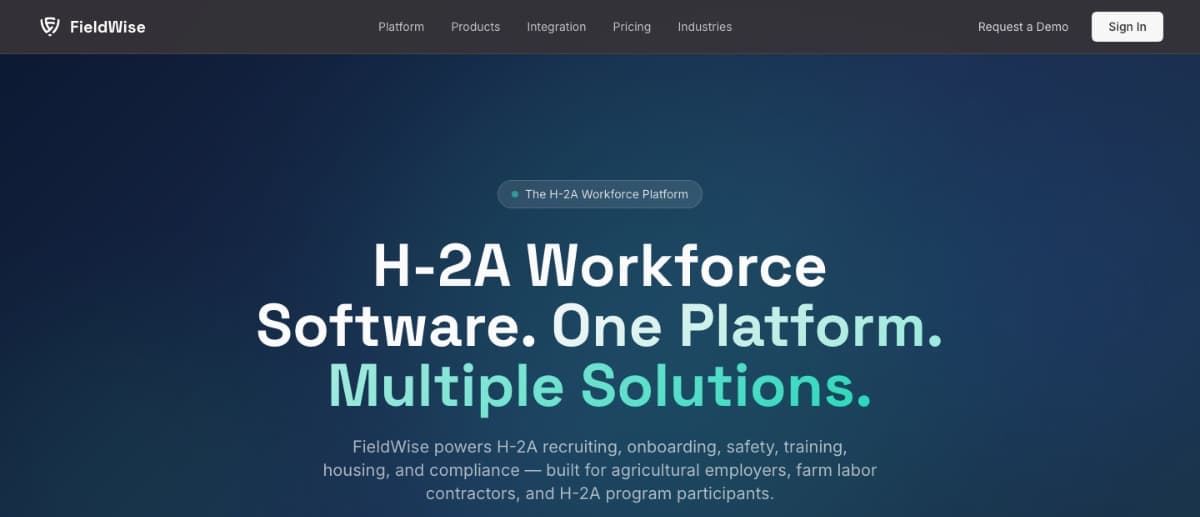
FieldWise homepage — 'H-2A Workforce Software. One Platform. Multiple Solutions.', describing coverage of recruiting, onboarding, safety, training, housing and compliance for agricultural employers and farm labor contractors.

Executive Summary

In a regulated workforce, the record is the product.

H-2A is a visa programme with real teeth. Employers have to evidence how workers were recruited, what they were trained on, where they were housed and how they were paid — and evidence it to an auditor, after the fact, sometimes long after the season ended.

The work itself was never the hard part. The hard part is that it happened across separate systems: one tool for recruiting, another for training, a spreadsheet for housing, paper for inspections. Each was defensible alone. Together they produced an audit trail that had to be assembled by hand, by whoever remembered.

FieldWise consolidates them into one platform with shared accounts, role-based permissions and a single compliance record — split into two integrated products, Ops for onboarding, operations and inspections, and Grow for training, safety education and certification, with training data flowing into operations automatically.

At a glance

Role
Product Manager
Organisation
Codingcops
Domain
AgTech · workforce compliance
Users
Agricultural employers, farm labor contractors
Timeline
2024 — 2025

Section 02 — The Problem

Every seam between tools is a hole in the audit trail.

Compliance

An audit asks one question of five systems.

Proving a worker was trained before being assigned to a task means joining a training record to an operations record. When those live in different tools, the join is a person with a spreadsheet and a deadline.

Field reality

The work happens where the software usually is not.

Onboarding, inspections and reporting happen in fields and housing sites, not at desks. Tools that assume an office produce records entered days later, from memory, if at all.

Seasonality

The workforce arrives all at once.

H-2A labour is seasonal and concentrated. A system that handles a steady trickle of onboarding can still collapse in the week a few hundred workers arrive together.

Section 03 — Research & Discovery

The unit of value is the record, not the screen.

Most workflow software is judged on how efficiently it lets someone complete a task. Compliance software is judged much later, by someone who was not there, on whether the resulting record proves what it needs to prove.

That inverts the design priority. A slightly slower flow that captures a defensible record beats a faster one that produces an ambiguous entry — because the cost of the ambiguity lands months later, in an audit, on the employer.

Method

Two users, opposite incentives, one system.

The supervisor entering data and the compliance manager depending on it want different things — speed at the point of capture, completeness at the point of audit. Research meant treating that conflict as the design problem rather than picking a side.

Method

Work backwards from the record an auditor asks for.

The useful starting question is not what the workflow should feel like, it is what has to be provable months later. Designing backwards from the auditor's request is what determined which fields were mandatory at capture instead of optional.

Section 04 — Current State Analysis

Two products, one account and one compliance record.

LayerFieldWise OpsFieldWise Grow
Primary workflowOnboarding, operations, inspectionsTraining, safety education, certification
Field usageReal-time reporting and task managementCourse delivery and skills assessment
SharedCentral accounts with role-based permissionsSame
SharedUnified compliance records and audit trailsSame
Data flowConsumes training and certification statusFeeds completion into operations automatically
Platform structure — what each product owns and what they share

Before / After

A stack of defensible tools became one defensible record.

The activities are identical either way. What changes is whether proving them takes a query or a person reconstructing a season from memory.

Before

Disconnected

Compliance assembled after the fact

  1. Recruit and onboard in one system

  2. Train in another, with no link back to the worker's operational record

    Manual join
  3. Track housing separately

  4. Reconstruct the audit trail by hand when an auditor asks

    Audit risk

Every record existed. Proving the relationship between them was somebody's memory and a spreadsheet.

After

One platform

Compliance as a by-product of doing the work

  1. One account and permission model across every workflow

  2. Training completion flows into operations automatically

  3. Housing, inspections and reporting captured in the field

  4. A unified audit trail that is queried, not assembled

The record is produced by the work itself rather than reconstructed from it afterwards.

1
Compliance record shared across every workflow
0
Manual joins between training and operations data

Section 05 — Competitive Research

The competitor is a spreadsheet that has never failed an audit yet.

In this category the realistic alternative is rarely a rival platform. It is a combination of point tools, paper and spreadsheets that the operator has used for years and that has not yet produced a penalty — which makes it feel proven, whatever its actual risk.

Selling against that is not a feature argument. It is a risk argument, and it only lands with someone who has either been audited or watched a peer be audited. That shapes who the product is sold to and what the first thirty days have to demonstrate.

The real alternative

Point tools that each work, plus a person holding them together.

Operators rarely evaluate a rival platform. They compare against the recruiting tool, the training provider and the spreadsheet they already run — a stack where every individual piece is defensible and only the joins are not.

What closes it

One question: can you produce the record right now?

The capability that changes the conversation is retrieving a complete worker trail on demand. Everything else in the platform is a feature comparison; that is the demonstration an operator who has been through an audit reacts to.

Section 06 — Key Insights

Three things that shaped the platform.

Insight 01

Split the products, share the record.

Ops and Grow are separate because the jobs and the buyers differ. They share accounts, permissions and the compliance trail because splitting those is what created the problem in the first place.

Insight 02

Automatic data flow is the whole value proposition.

Training feeding into operations without anyone re-entering it is not a convenience feature. It is the difference between a provable record and an assembled one.

Insight 03

Design for the worst week, not the average one.

Seasonal arrival means capacity is defined by the peak. A system sized for typical load is a system that fails exactly when the compliance exposure is highest.

Section 07 — Design Strategy

Four rules for software an auditor will eventually read.

  1. Capture the record where the work happens.

    A record entered days later from memory is weaker evidence than a slightly rougher one captured in the field.

  2. Never make a human join two systems.

    Every manual reconciliation is a place the audit trail can silently break.

  3. One identity and permission model across every product.

    Separate account systems recreate the silos the platform exists to remove.

  4. Size for the arrival peak.

    Seasonal workforces do not ramp; capacity has to hold on the week everyone lands at once.

Section 08 — The System

Every worker record carries a compliance state.

Onboarded

Recruited and enrolled, with identity and documentation captured. Not yet cleared for all assignments.

Certified

Required safety training completed in Grow, with the completion visible to Ops automatically — the state that unlocks assignment.

Auditable

The full trail — recruiting, training, housing, activity — retrievable as one record. Retention has to outlast the audit window, not the season, which is what makes this a platform requirement rather than a reporting feature.

Section 09 — The Features

What the platform does.

FieldWise homepage describing the H-2A workforce platform covering recruiting, onboarding, safety, training, housing and compliance.
Platform

One account layer under two products.

Central user accounts with role-based permissions, unified compliance records and audit trails shared across applications, and enterprise infrastructure sized for organisations scaling their H-2A operations.

1Supervisor captures in the field2Entry attaches to the worker record3Operations sees it immediately4Audit trail grows continuously
Field capture flow — a supervisor logs an inspection on site, the entry attaches to the worker record, operations sees it immediately, and the audit trail grows as the season runs.
Ops

Onboarding, operations and inspections in the field.

Real-time field reporting and task management, so the operational record is captured where the work happens rather than reconstructed at a desk afterwards.

1Training delivered in Grow2Certification recorded as data3Status appears in Ops, no re-entry4Worker cleared for assignment
Certification flow — training delivered in Grow becomes structured data, appears in Ops without re-entry, and clears the worker for assignment.
Grow

Training that updates the operational record on completion.

Safety education, skills certification and training delivery, synchronised automatically into operations so certification status is a fact the platform knows rather than a document someone files.

Section 10 — User Flow

The compliance record assembles itself as the season runs.

  1. A worker is recruited and onboarded.

    Identity, documentation and role captured once, into an account the whole platform shares.

  2. Required training is delivered and certified in Grow.

    Completion becomes structured data rather than a certificate in a folder.

  3. Certification appears in Ops without re-entry.

    The automatic flow between products — and the step that removes the manual join the old stack depended on.

  4. Field activity, housing and inspections are logged against the same record.

    Each entry attaches to the worker, so the trail builds continuously instead of being assembled at audit time.

  5. The audit trail is queried, not reconstructed.

    The moment the platform justifies itself. If producing the trail still needs someone to assemble it, every upstream decision was decoration.

Section 11 — End-User Experience

The people entering the data are not the people who benefit from it.

A crew supervisor logging an inspection gets nothing from doing it well. The benefit lands months later with a compliance manager they may never meet. That gap is the core adoption problem in this kind of software, and no amount of dashboard design fixes it.

What does work is making the capture step genuinely faster than the paper it replaces, on a phone, in a field, possibly in a second language. If it is slower, it will be done late and badly, and the record will be worth less than the one it replaced.

Two constraints follow directly and neither is negotiable: it has to work on a phone, and it has to survive poor connectivity. A compliance record that only exists when there is signal is a compliance record with holes in exactly the places the work actually happens.

Section 12 — Impact & Outcomes

What the platform proves, and what still needs measuring.

2
Integrated products sharing one compliance record
6
Workflows unified onto one platform

The figures above describe the platform's shape rather than a result attributable to you. The site references hundreds of companies using it but publishes no performance, cost or compliance metrics, so nothing of that kind is claimed here.

Performance figures are not published, so none are claimed. The three that would settle it are audit-prep time, onboarding throughput during the arrival peak, and field-capture completion rate — the last being the leading indicator, because a record that is not captured cannot be proven later.

Section 13 — Reflection

What I would do differently, and what is still open.

Would do differently

Test field capture in the worst conditions first, not the best.

Capture was the load-bearing decision, and the realistic environment for it is a phone, outdoors, mid-task, possibly in a second language. Validating there before validating in an office would have set the design constraints rather than confirming them late.

Still open

The person entering the data still gets nothing from it.

The incentive gap is structural, not a UX problem. Until capture is genuinely faster than the paper it replaced, the quality of the compliance record depends on goodwill from someone who will never see the benefit of it.

WhatsApp